


A modern high-tech drone is far more than a frame with motors and propellers; it is a fully capable airborne computer. Such an aircraft must operate within a highly complex cyber environment while subjected to persistent Electronic Warfare (EW). Most developments on the market follow the path of least resistance: manufacturers take open-source flight controllers and build custom add-ons on top of them. However, open-source code carries a fundamental flaw — it is accessible to everyone. Adversaries understand the intricate inner workings, core operating principles, and inherent vulnerabilities of such systems, making it significantly easier to exploit the drone, spoof signals, or hijack control.
Reactive Drone has taken a fundamentally different, engineering-first approach. The security of our unmanned aerial systems relies on a closed ecosystem where every layer—from physical servers to the radio frequency spectrum—remains under absolute control.
Proprietary Flight Controller: The Advantage of Closed Protocols
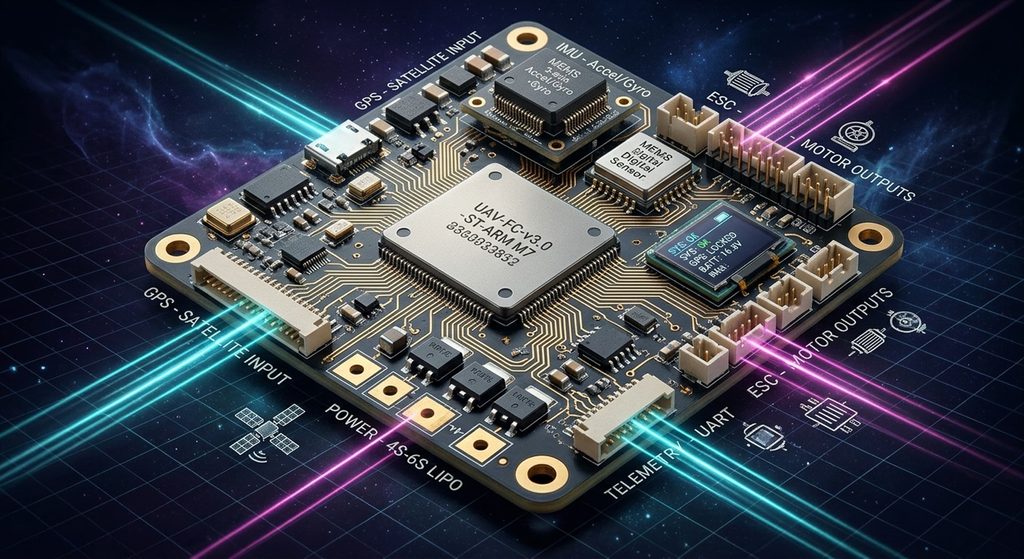
The flight controller serves as the brain of every UAV, accepting pilot commands, processing sensor telemetry, and computing flight trajectories. Reactive Drone flight controllers are not open-source solutions. They are proprietary, in-house developments utilizing closed protocols, with access strictly limited to our engineering team.
The foundation of this architecture was established back in 2018–2019 within the agricultural sector. Reactive Drone accumulated data across tens of thousands of real-world flight hours, enabling our software engineers to design custom control flight math and algorithms. Following Russia’s full-scale invasion of Ukraine, these commercial developments underwent comprehensive modernization. Security constraints were substantially strengthened, closing the controllers to any external access and fully aligning them with military specifications.
Practical Operational Advantages
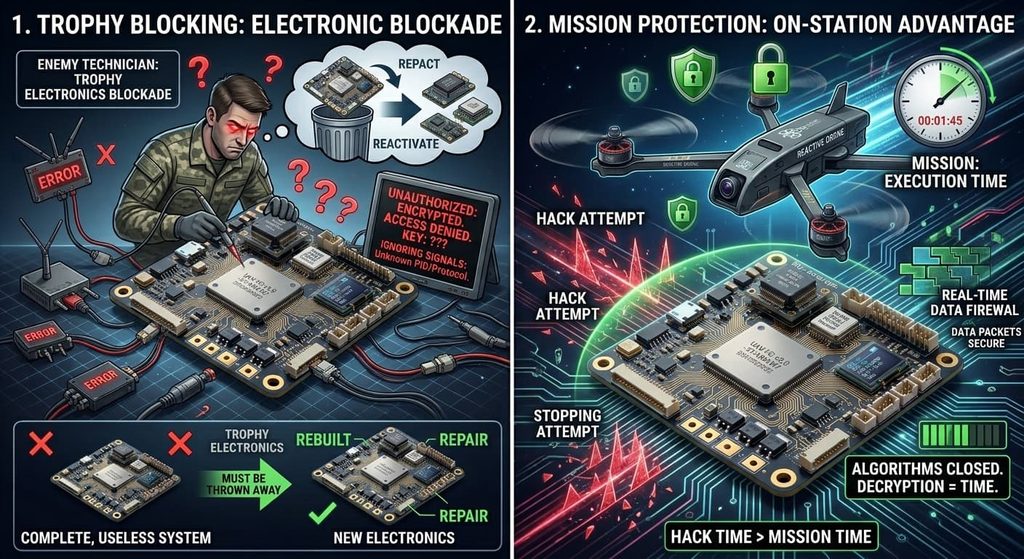
1. Denial of Captured Hardware (Trophy Prevention):
If a drone comes down in enemy territory intact, the adversary cannot make it fly again. External parties have no insight into what specific signals the controller expects or how it processes them. To utilize captured hardware, the enemy would have to completely strip out all onboard electronics and build a new wiring harness and avionics stack from scratch.
2. In-Flight Mission Protection:
Any exploitation or reverse-engineering attempt requires significant time. Because the underlying control algorithms are closed, decrypting or exploiting them mid-air during the limited window of a tactical mission is virtually impossible.
Server and Data Security: An Unbroken Perimeter
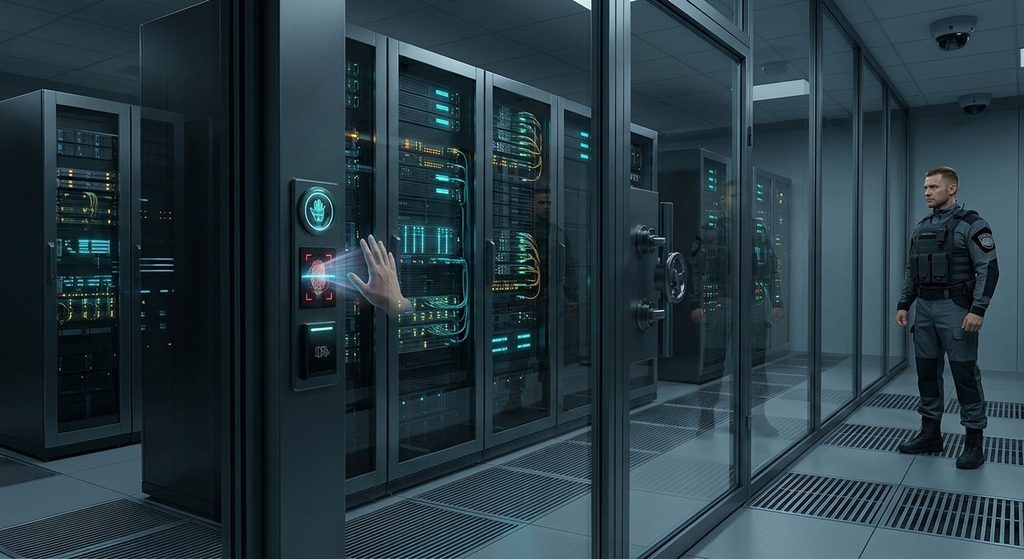
Cybersecurity does not stop at the aircraft itself. All telemetry and mission data generated by our systems are processed on proprietary servers located within Ukraine and Europe.
We intentionally avoid third-party cloud infrastructure. The company maintains direct physical and software control over its server hardware, restricting external personnel and third-party cloud providers from server facilities. This setup ensures complete oversight of sensitive data transmission — matching the security standards of leading global defense enterprises.
Digital vs. Analog Communications: Why Interception Is Impossible
Footage circulating online often shows civil or FPV drones being hijacked using high-power transmitters or radio signal interception. This vulnerability is inherent to analog communication links, where signals are transmitted much like a standard radio broadcast: identify the frequency, override it with a stronger signal, and the drone accepts input from a foreign pilot. Properly encrypting an analog link is technically impossible.
Reactive Drone platforms have been engineered from day one to rely exclusively on cryptographically secured digital communication links:
– Mutual Authentication and Handshake: Upon boot-up, the remote controller and the UAV establish a secure link through mutual encryption key exchange and identification based on an automated friend-or-foe protocol.
– Closed Point-to-Point Connection: Once the link is established, the devices communicate strictly via proprietary closed algorithms and exclusively with each other (or within a defined network of authorized devices).
– Military-Grade Encryption Standards: To secure the data stream, state-of-the-art cryptographic algorithms are deployed, including those utilized in NATO-standard military hardware.
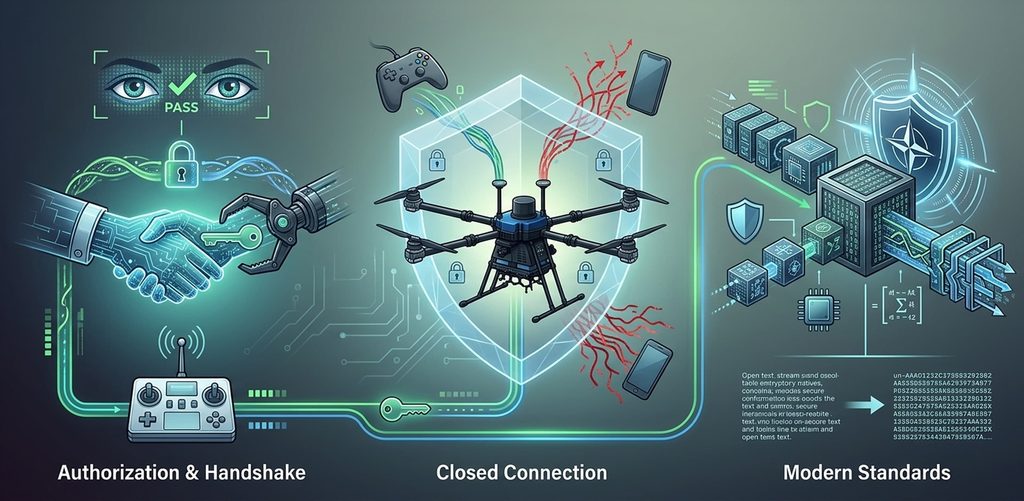
Infiltration or connection to this channel from an unauthorized device is technically impossible. Overriding control, extracting flight logs and route data, or intercepting the onboard video feed without authorization keys cannot be achieved. The only entity maintaining command over the aircraft in contested airspace is the authorized pilot.
The combination of a proprietary closed flight controller, secured server infrastructure, and military-grade digital encryption transforms Reactive Drone platforms into hardened, highly resilient unmanned systems engineered to execute missions under extreme Electronic Warfare conditions.