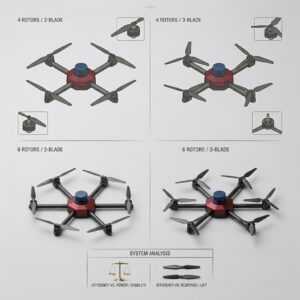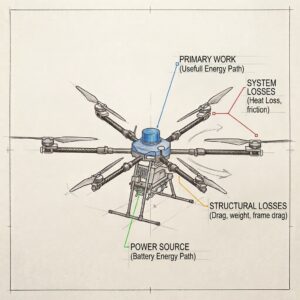



When evaluating UAV performance, discussions typically center on motor power output, battery capacity, signal range and stability, or airframe aerodynamics. Yet even the fastest drone is merely a carrier. In real-world combat conditions, true operational impact lies elsewhere. Logistics and strike UAVs are defined by one critical assembly: the payload attachment and release system.
This exact component elevates an aerial platform into a precision instrument, enabling UAVs to deliver munitions, medical supplies, and critical logistics items with surgical accuracy.
The “Baba Yaga” Phenomenon: From Garage Conversions to Military Standards
Understanding the necessity of drop mechanisms requires examining the evolution of heavy tactical UAVs, colloquially grouped under the “Baba Yaga” class.
When Russia’s full-scale invasion began in early 2022, Ukrainian forces faced a critical shortfall: overwhelming enemy numbers, a fluid frontline, and a severe shortage of standard precision-guided munitions. However, military depots held extensive stockpiles of unguided ordnance—anti-tank and mortar mines, artillery shells, and infantry grenades.
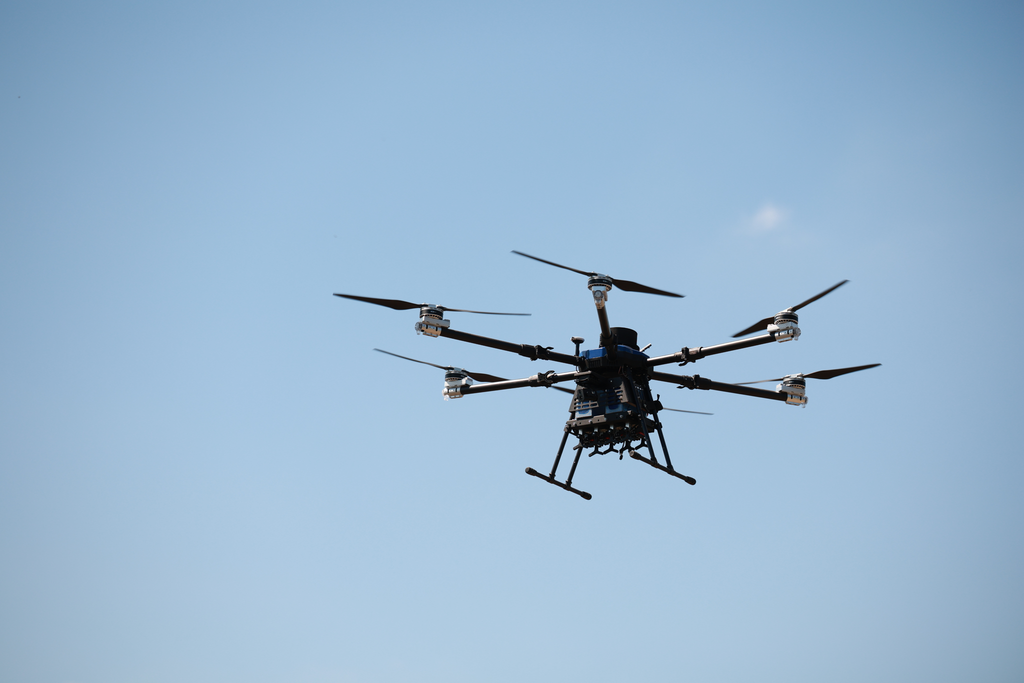
This environment birthed the KAZHAN drone, one of the pioneers of the “Baba Yaga” class. Originating as an engineering adaptation of heavy agricultural multirotors, the KAZHAN solved the core dilemma: carrying 10 to 30 kg of payload over ranges of 10–20 kilometers (and up to 25 km today).
The key driver behind the widespread adoption of these heavy bombers was their ordnance-agnostic design. Unlike conventional military aviation, where hardpoints are engineered around rigid missile or guided bomb (PGB) specifications, the KAZHAN could deploy virtually any explosive payload:
- Mortar rounds (82 mm, 120 mm)
- Anti-tank landmines (TM-62)
- Incendiary and napalm charges
- Repurposed cluster munitions
- Anti-tank aerial bombs
- Custom improvised engineering charges
Military history offers few precedents of mass vertical bombing directly over the forward line of own troops. Field fortifications, dugouts, and armored vehicles are primarily built to withstand horizontal impact (artillery, ATGMs) and remain highly vulnerable to direct top-down strikes at a 90-degree angle.
The Engineering Challenge: Universal Fit vs. Operational Safety
Accommodating diverse ordnance presented developers with a complex design dilemma: how to engineer a release mechanism that securely holds flat anti-tank mines, complex mortar shell geometries, or cylindrical charges, while ensuring absolute safety for the crew?
Frontline operational requirements demanded strict criteria:
1. Versatility: The capacity to mount anywhere from 1 to 4 (and up to 6–8 on specialized variants) munitions of varying mass and dimensions.
2. Field-Friendliness: Operators must load the aircraft in pitch darkness, sub-zero temperatures, or prone in trenches without specialized tools.
3. Reliability and Safety: Zero tolerance for mechanical failure—accidental snags or operator error must never cause unintended releases or premature arming.
Anatomy of Modern Drop Systems: Three Pillars of Design
Four years of rapid evolution—transitioning from rudimentary pull-cables, mechanical latches, and hobbyist RC servos—led engineers at Reactive Drone to a refined three-part architecture.
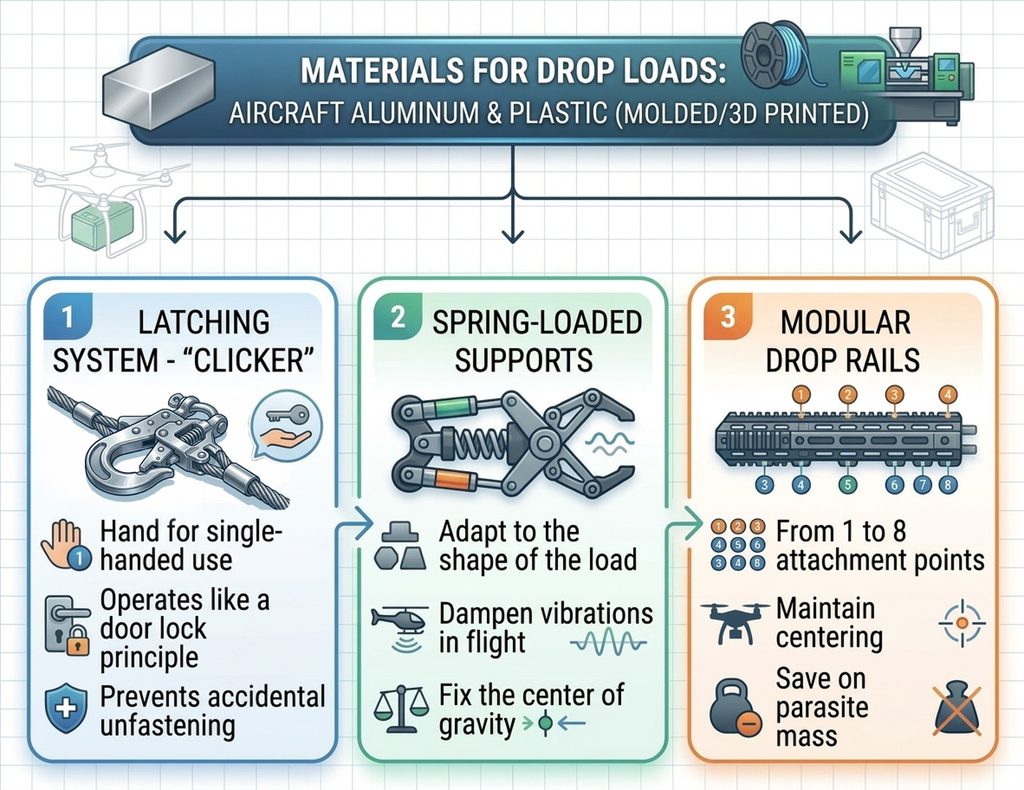
1. The Snap-Lock Latch (Mechanical Retention)
Engineered similarly to a heavy-duty door latch, this mechanism allows operators to load a munition single-handedly until an audible click confirms engagement. Internal levers and spring assemblies mechanically lock the payload, preventing accidental release without a dedicated mechanical or electronic actuation command.
2. Spring-Loaded Stabilizers (In-Flight Suppression)
Securing the load is only half the battle; preventing sway is equally critical. Payload oscillation during flight introduces parasitic drag, shifts the aircraft’s center of gravity (CG), and degrades flight controls. Spring-loaded dampers automatically conform to the geometry of the specific item, clamping it securely to eliminate play and vibration.
3. Modular Rails and CG Management (Adaptable Configurations)
The drop mechanisms mount onto modular release rails fixed to the airframe with one or two bolts.
– Weight Optimization: Unused rails are easily removed for single-payload missions to eliminate parasite mass.
– Mass Balance (Center of Gravity): Single-payload runs mount the rail directly over the aircraft’s center of gravity. For multi-payload missions (2 or 4 rounds), rails are positioned symmetrically along the central axis to preserve flight stability.
The structural assembly utilizes aircraft-grade aluminum for load-bearing members, high-strength molded and 3D-printed polymers, and specialized steel springs and hardware.
The “Tow Lug”: Aviation Engineering at Minimal Cost
To mate non-standard ordnance to the release mechanism, engineers introduced a low-cost adapter known as the “tow lug” (prychep).
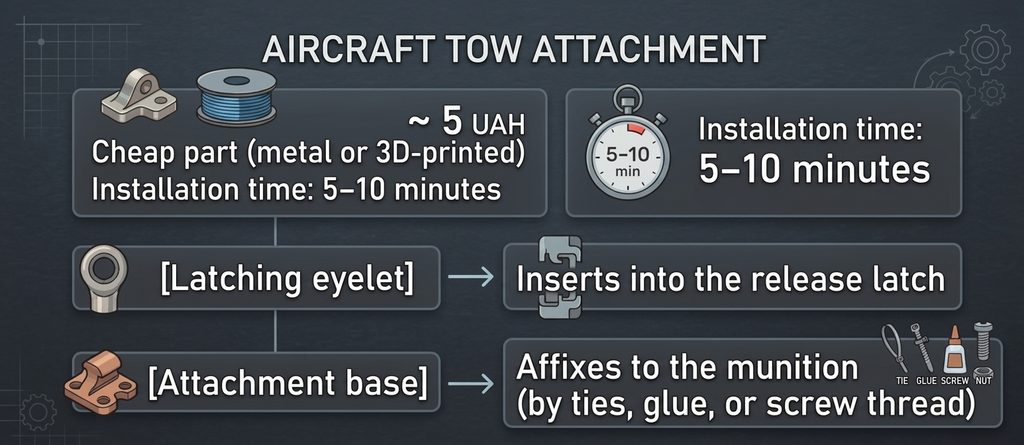
Borrowed from conventional aviation—where similar hardpoint lugs are integrated into bombs, torpedoes, and external fuel tanks—this component is extremely cost-effective (costing around 5 UAH / ~$0.12). It can be stamped from metal or 3D-printed in high volumes.
– Field Adaptations: Attached to mortar mines or improvised charges via heavy-duty zip-ties or epoxy resins within 5–10 minutes.
– Factory Ordnance: Integrated directly into the casing during factory manufacturing.
Multi-Layered Safety: Preventing Accidental Releases
In combat operations, a single mistake risks crew lives and critical equipment. To mitigate this, the release system incorporates a triple-redundant safety framework:
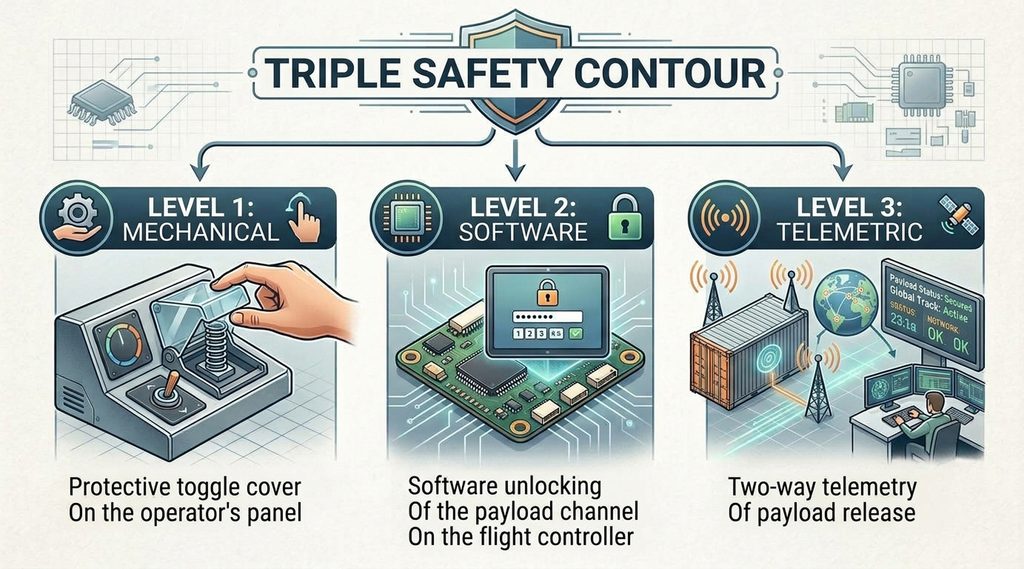
1. Physical Controller Guard: The release switch on the pilot’s ground control station features a spring-loaded switch guard (similar to fighter jet missile triggers) to prevent accidental activation by gear or elbow contact.
2. Software Interlocks: Flight controllers require secondary command confirmation to energize and unlock the arming channel prior to weapon release.
3. Manual Disarm Lever: If a drone returns from a mission with unexploded ordnance (UXO), operators can manually disarm the system using a recessed ground-release lever designed to avoid accidental snags during transport.
4. Payload Telemetry: Real-time telemetry feeds display active hardpoint connections and provide visual confirmation of payload separation for each channel.
Universal drop mechanisms demonstrate how sound aerospace engineering and practical field requirements merge into a single reliable assembly. Through precise mechanical design, an ordinary aerial platform becomes a flexible, safe, and highly effective weapon system.