


A drone is only as good as its motors’ raw power and maximum thrust. That is likely how the average person views UAV performance. In reality, this is one of the most common myths in unmanned aviation.
The logic seems straightforward: the more Newtons or grams of thrust a motor delivers, the more weight it can lift or the faster it can accelerate to top speed. Real-world aerodynamics and electrical engineering, however, show a different situation. Attempting to get 100% of a propulsion system’s potential yields rapidly diminishing returns.
Empirical testing shows that once a motor reaches peak thrust, system efficiency doesn’t just plateau; it drops off a cliff, often by more than half.
Where Does the Energy Go?
All modern multirotor drones, from compact FPV platforms to heavy cargo lifters, rely on brushless DC (BLDC) motors. While BLDC motors offer exceptional power density and reliability, they remain bound by the fundamental laws of thermodynamics and electromagnetism.
When a brushless motor operates at 90%–100% of its maximum thrust, two critical inefficiencies occur simultaneously:
1. Nonlinear Thermal Losses: According to Joule’s Law, heat generated in a conductor is proportional to the square of the current (I2R). Extracting that final 20% of thrust requires a massive increase in current. Most of this additional energy turns directly into waste heat rather than useful mechanical work, overheating the motor coils and warming the surrounding air.
2. Aerodynamic Rotor Drag: Aerodynamic drag on a propeller scales with the square of its rotational speed, while the power required to overcome that drag scales with the cube of the rotation speed. At peak RPM, the blades begin to “slip” through the airflow, causing specific thrust (grams of thrust per watt of power, or g/W) to plummet.
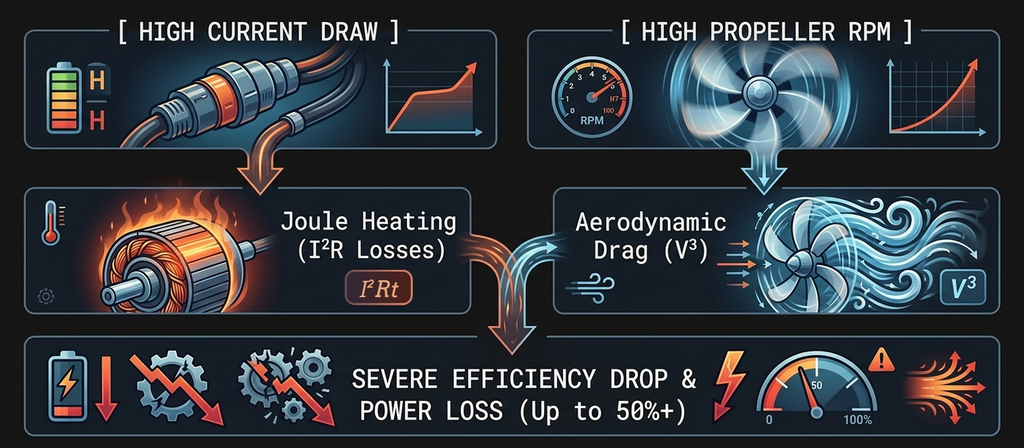
High current draws don’t just heat motor windings; they place immense stress on the battery pack. This induces voltage sag, raising the battery’s internal resistance and temperature while rapidly depleting its usable capacity. The result is significantly reduced flight times and an increased risk of mid-air power cutouts.
The Sweet Spot: What Empirical Testing Reveals
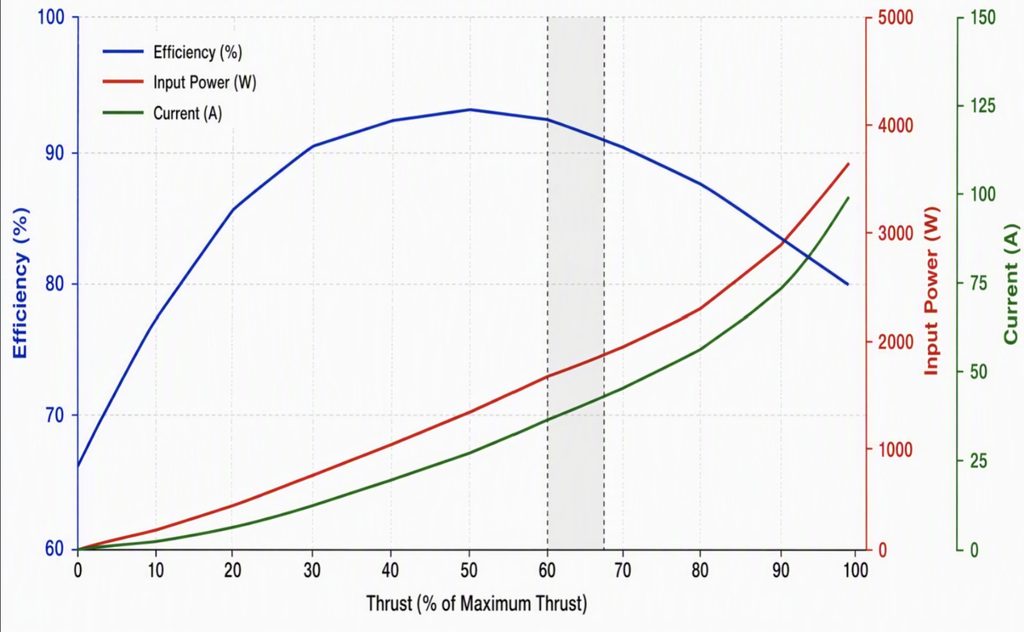
Bench testing and field trials of propulsion systems consistently show that a brushless motor’s efficiency curve forms an inverted parabola.
The highest energy efficiency occurs in the 60%–65% maximum thrust window. Within this range, the ratio of lift generated to power consumed is maximized, and operating temperatures remain safely within nominal bounds. Running that same motor at 90%–100% thrust reduces its efficiency by more than 50% compared to its peak operating point.
Engineering for Margins: Reliability First
A sound drone design philosophy must account for these physical realities. “Reactive Drones” consciously avoid chasing extreme peak figures. This is the common practice when engineering propulsion platforms across its entire line of UAVs—including the KAZHAN 620 (BAT 620), KAZHAN 630 (BAT 630), and SHMAVIK.
Instead of pushing motors to their absolute limits, engineers size the propulsion system with intentional power margins. This ensures that cruise flight with a full payload occurs squarely within the optimal 60%–65% efficiency window.
Key Advantages of This Engineering Approach
Extended Mission Endurance: Batteries deliver power under optimal load profiles without overheating or suffering premature degradation.
Reduced Component Failure Rates: Motors operate within safe thermal limits, mitigating the risk of inter-turn short circuits and neodymium magnet demagnetization.
Maneuver Power Reserve: In high-wind conditions or emergency evasive maneuvers, the drone retains a physical power reserve that can be tapped briefly without risking instant system failure.
Experience shows that in unmanned aviation, the superior platform isn’t the one that achieves a brief, self-destructive burst of speed; it is the one engineered with safety margins, operating at peak efficiency from takeoff to landing.