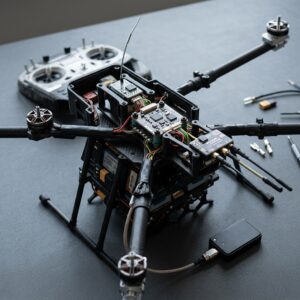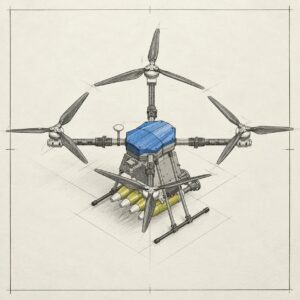



A modern combat drone is a sophisticated, hardware-and-software integrated complex. A tactical UAV must not only execute its mission and return to base, but it must also feature adaptable control modes and highly resilient navigation engineered to withstand active electronic warfare (EW). The KAZHAN 620, KAZHAN 630, and SHMAVIK platforms are designed around this exact engineering philosophy.
Three Primary Flight Modes and Failsafe Protocols
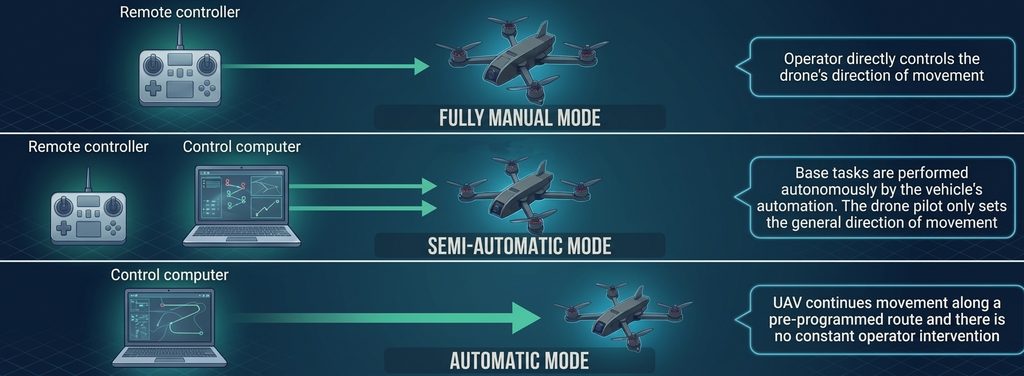
Depending on the tactical objective and the intensity of enemy EW suppression, the operator can select from three core control modes:
1. Fully Manual Mode:
The operator directly controls the drone’s velocity and trajectory vectors. The flight controller handles baseline attitude stabilization — maintaining the artificial horizon, dampening turbulence from wind gusts, and preventing atmospheric stalls or roll inversion.
2. Semi-Autonomous Mode:
The onboard avionics handle core baseline flight tasks independently while the pilot dictates the general heading. The UAV automatically maintains altitude, holds a stationary hover over a target, or initiates automated Return to Home (RTH) routines.
3. Autonomous Mode:
The drone executes a pre-programmed waypoint mission without requiring continuous operator intervention or live data links.
Failsafe Protocols: Emergency Scenarios
When signal interference occurs mid-mission, automated emergency response (Failsafe) protocols are instantly triggered. Our engineers have developed three distinct contingency workflows:
Active Navigation / Loss of Control Link:
The UAV maintains its operational path along the assigned waypoint trajectory or initiates an automated Return to Home routine along a pre-designated safe corridor.
Loss of Navigation / Active Control Link:
The drone automatically disables compromised satellite geolocation telemetry, transferring attitude hold to manual pilot control. The operator navigates the platform back to base visually or via live video feed.
Simultaneous Loss of Navigation and Control Link:
The platform immediately triggers an automated hover-and-drift or controlled descent/inertial recovery protocol to prevent the aircraft from falling into enemy hands intact.
Multi-Frequency, Multi-Constellation GNSS Array

Operating in heavily jammed airspace requires continuous, high-precision positioning data provided by a dedicated GNSS module. At Reactive Drone, the GNSS architecture is a proprietary in-house hardware design — a custom PCB engineered to process signals across multiple global positioning constellations: GPS (USA), Galileo (EU), BeiDou (China), QZSS / Michibiki (Japan).
The array operates across standard civilian L1 and L2 frequencies while actively leveraging the L5 frequency band.
Why L5 Matters: Signals in the L5 band feature higher transmission power, wider bandwidth, and significantly lower prevalence across civilian infrastructure—making them exceptionally difficult to jam using standard trench-level EW systems.
Smart GNSS Architecture: Physical and Software Anti-Jamming Protection
Conventional navigation receivers completely lose lock when subjected to high-power directional noise. Our platforms utilize a Smart GNSS module engineered from the ground up to operate in synergy with our proprietary flight controller.
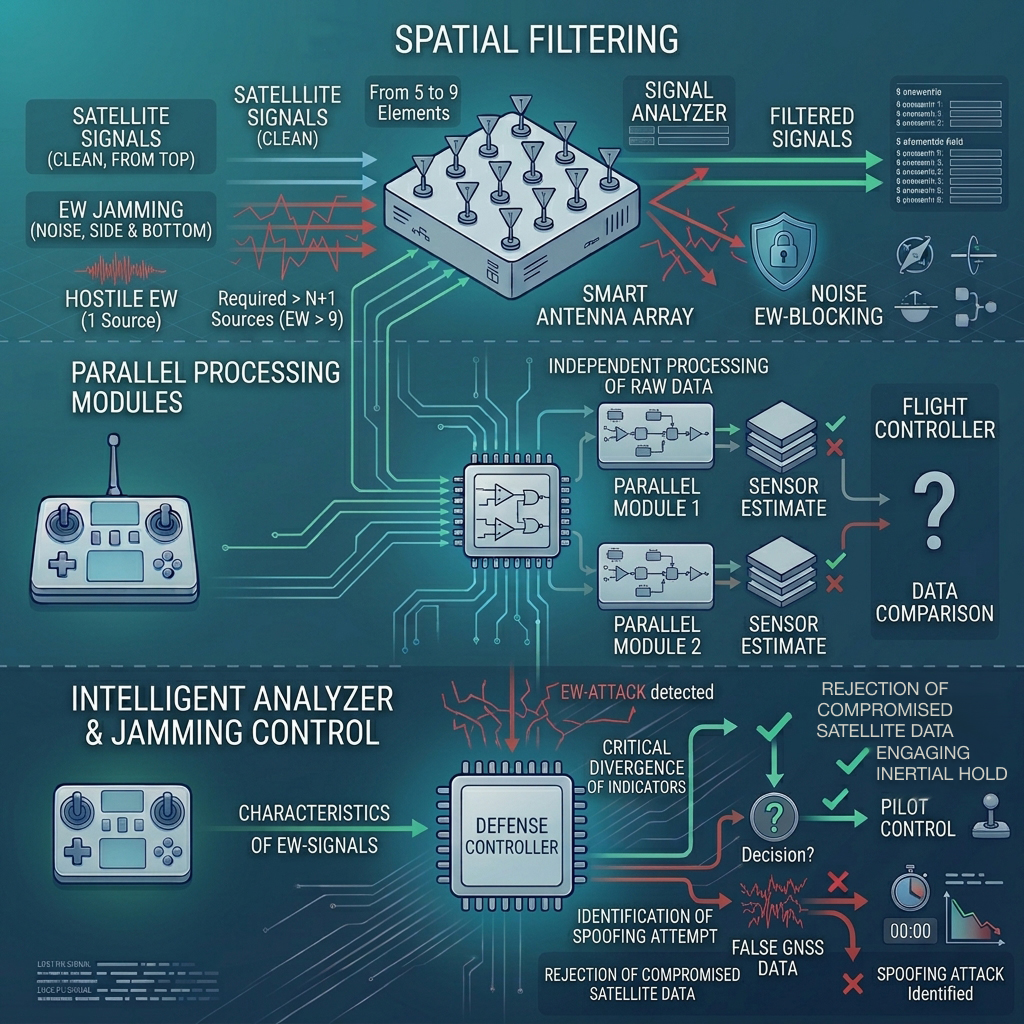
Navigation protection is implemented at three levels:
1. Spatial Filtering (Controlled Reception Pattern Antenna Array)
The Smart GNSS is equipped with a spatially separated antenna array comprising 5 to 9 discrete elements. Under the laws of RF physics, fully suppressing an N-element receiving array with directional noise requires an adversary to deploy at least N +1 jammer sources emitting from distinct spatial vectors. Because most tactical EW interference originates from ground level or low elevation angles, the system physically and algorithmically rejects noise arriving from below and the sides, isolating clean satellite signals from above.
2. Parallel Processing Modules
Signals from the antenna array feed into two parallel computing cores that independently process raw telemetry, filter out harmonic distortion, and feed verified positioning coordinates to the flight controller.
3. Intelligent Spoofing Detection
The flight controller continuously cross-checks incoming telemetry from various receivers and frequency channels. If coordinate data diverges critically — a key indicator of GPS spoofing — the system instantly identifies the EW attack, rejects compromised satellite data, engages inertial hold, and hands full manual authority over to the pilot.
The seamless integration of a proprietary flight controller with smart navigation architectures ensures Reactive Drone platforms maintain operational integrity where conventional systems suffer total loss of spatial orientation.