


Quadcopter or hexacopter? Which configuration is better? This question sparks endless debate among UAV engineers, while drone operators test competing hypotheses in real-world combat conditions every day.
Which way do the scales tip when comparing four-rotor platforms to six-rotor systems? Adding as many motors as possible might seem like the logical choice at first glance. In reality, however, the trade-offs are far less straightforward. Aerodynamic laws and modern battlefield experience both prove one fundamental truth: there is no silver bullet.
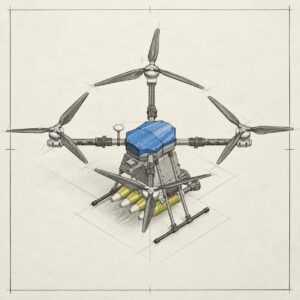
The best way to examine the merits of each architecture is by looking at two heavy-lift tactical UAVs manufactured by Reactive Drone: the KAZHAN 620 quadcopter and the KAZHAN 630 hexacopter. The total motor count and blade geometry directly dictate the operational philosophy of each aircraft, and fundamentally shape their technical and tactical specifications.
Aerodynamic Antipodes: 4 Motors vs. 6 Motors
The core difference between these two drones isn’t just the number of power units. It extends deep into the geometry of their propulsion systems:
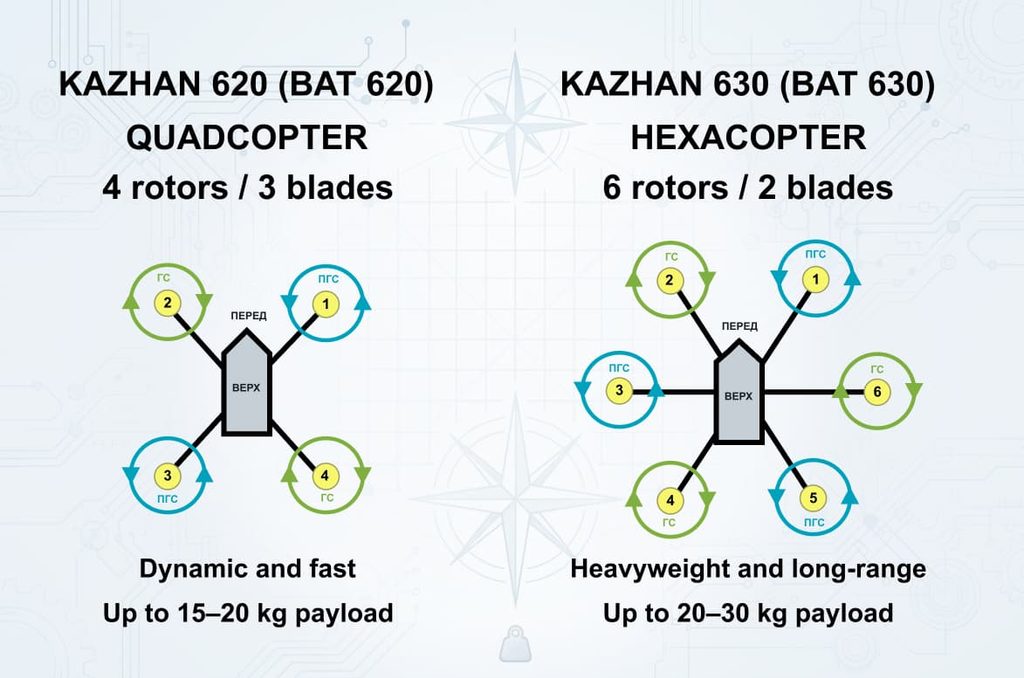
– KAZHAN 630 (Hexacopter): Equipped with 6 brushless electric motors, each driving a 2-blade propeller.
– KAZHAN 620 (Quadcopter): Equipped with 4 brushless electric motors, each driving a 3-blade propeller.
This specific configuration was selected after rigorous bench testing and extensive flight trials. Engineers evaluated the KAZHAN 620 with various arm lengths and propeller designs, engineering two-, three-, and four-blade rotor prototypes. For this particular quadcopter frame, the 3-blade setup demonstrated optimal energy efficiency, extracting maximum combined thrust from a significantly smaller frame footprint.
KAZHAN 630: The Heavyweight Striker
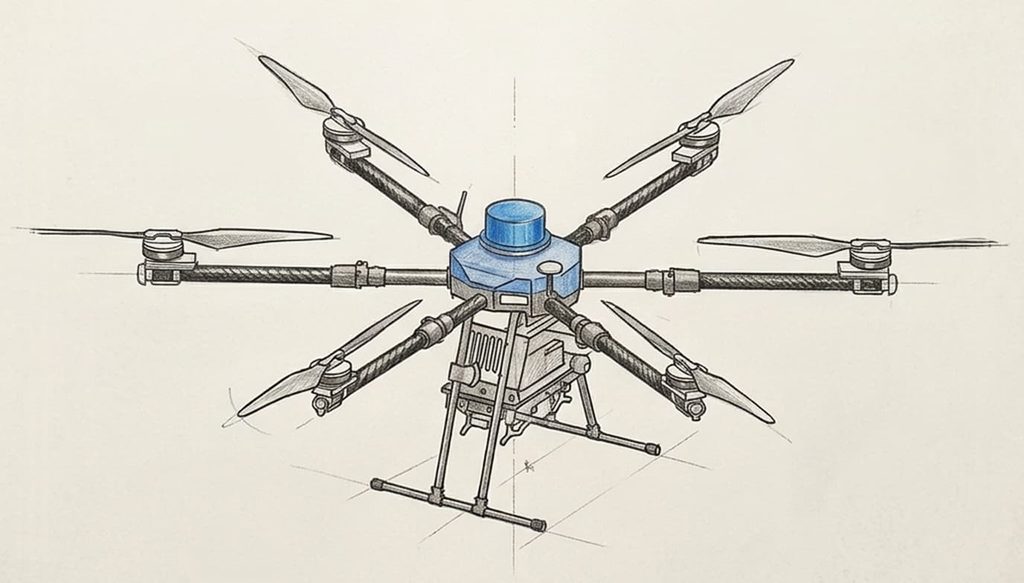
A six-motor setup offers a decisive advantage in overall thrust capacity.
Payload Capacity & Power
The hexacopter is engineered ground-up as a heavy-duty cargo delivery and strike system. The net payload capability of the KAZHAN 630 is impressive:
Up to 30 kg on shorter tactical missions.
Up to 20 kg on long-range operational sorties.
Because adding more rotors increases total available thrust at a much higher rate than it adds structural weight, the KAZHAN 630 achieves an exceptional useful-load-to-weight ratio.
Flight Dynamics and Inertia
To draw an automotive analogy, the KAZHAN 630 is the heavy-duty semi-truck of the skies. Its larger physical footprint combined with heavy payload weight creates significant rotational and translational inertia.
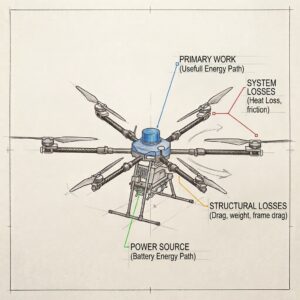
Accelerating or stopping a high-mass platform requires more time, control effort, and kinetic energy. Sharp maneuvers or aggressive joystick inputs drain battery capacity at a rapid rate. Consequently, the KAZHAN 630 is flown deliberately along smooth, calculated flightpaths, and its top speed is intentionally capped at a lower threshold.
The primary trade-off of this platform lies in its transport ergonomics: its wide diagonal frame footprint makes transport more demanding, taking up substantial space in a pickup truck bed or when man-portable by a team.
KAZHAN 620: The High-Speed Sprinter
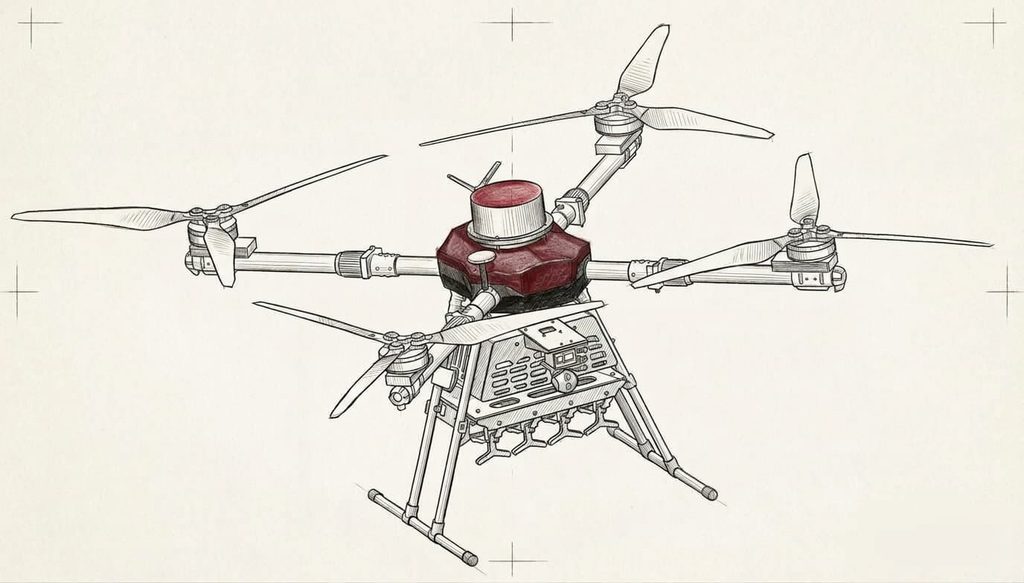
Trading two motors for high-efficiency 3-blade propellers yielded a noticeably more compact, lightweight, and agile system.
Form Factor and Field Ergonomics
From a structural standpoint, the KAZHAN 620 excels in field usability. It is significantly smaller and easily manageable by a single operator. Furthermore, a support crew can pack substantially more quadcopter units into a single transport vehicle compared to the larger hexacopters – a crucial factor when rapidly relocating positions under fire.
Speed and Agility
Thanks to lower gross weight, reduced drag from the airframe, and optimized 3-blade aerodynamics, the KAZHAN 620 is built for speed. Its cruising and maximum speeds are 5 to 10 m/s faster than the KAZHAN 630 (representing a 20–30% speed advantage). This enables the drone to dash through enemy air-defense and detection zones much faster.
Payload Trade-offs
The price paid for speed and mobility is a reduced payload envelope:
Up to 20 kg over short distances.
12–15 kg over extended operational ranges.
Platform Comparison Profile
| Feature / Metric | KAZHAN 620 | KAZHAN 630 |
| Power Unit | 4 Motors / 3-Blade Props | 6 Motors / 2-Blade Props |
| Payload Allowance (Short Range) | Up to 20 kg | Up to 30 kg |
| Payload (Long Range) | 12 – 15 kg | Up to 20 kg |
| Top Speed | Up to 120 km/h | Up to 90 km/h |
| Flight Characteristics | Dynamic, agile, responsive | Smooth, deliberate, high-inertia |
| Ergonomics | High (Compact footprint) | Moderate (Requires larger cargo space) |
Battlefield Synergy: The Power of the Tandem
It is impossible to declare one platform definitively superior to the other. The KAZHAN 620 and KAZHAN 630 were designed for distinct tactical roles, and each represents a highly optimized tool for its respective mission profile.
In practice, maximum operational effectiveness is achieved when deploying both platforms in tandem:
1. The KAZHAN 620 leads the charge or acts during time-sensitive situations. It excels when maximum speed, rapid delivery of medium payloads, or flying through hostile EW environments is required, and where high transit speed is the key factor in surviving the approach line.
2. The KAZHAN 630 follows along secured or cleared corridors to deliver massive fire impact with heavy munitions or transport bulky logistics cargo, excelling in precise hover stability and maximum payload delivery.
By combining high-speed quadcopters with heavy-lift hexacopters, frontline units can cover 100% of their tactical mission profiles efficiently, optimizing battery resources while reducing crew exposure to enemy threats.