


Without a reliable radio link, even the most advanced drone is reduced to little more than a “brick.” Video streaming, telemetry transmission, and control inputs must function flawlessly from takeoff to return-to-base (RTB). However, under brutal electronic warfare (EW) environments, standard civilian solutions fail—you cannot violate the laws of physics, but you can bypass them through clever engineering.
In the KAZHAN 620/630 and SHMAVIK unmanned aerial systems, this challenge is tackled through a holistic hardware-software approach. Superior link resilience is achieved via dual broad frequency spectrums, advanced Frequency-Hopping Spread Spectrum (FHSS) algorithms, and high-power ground segment equipment.

Frequency Bands and Their Physical Characteristics
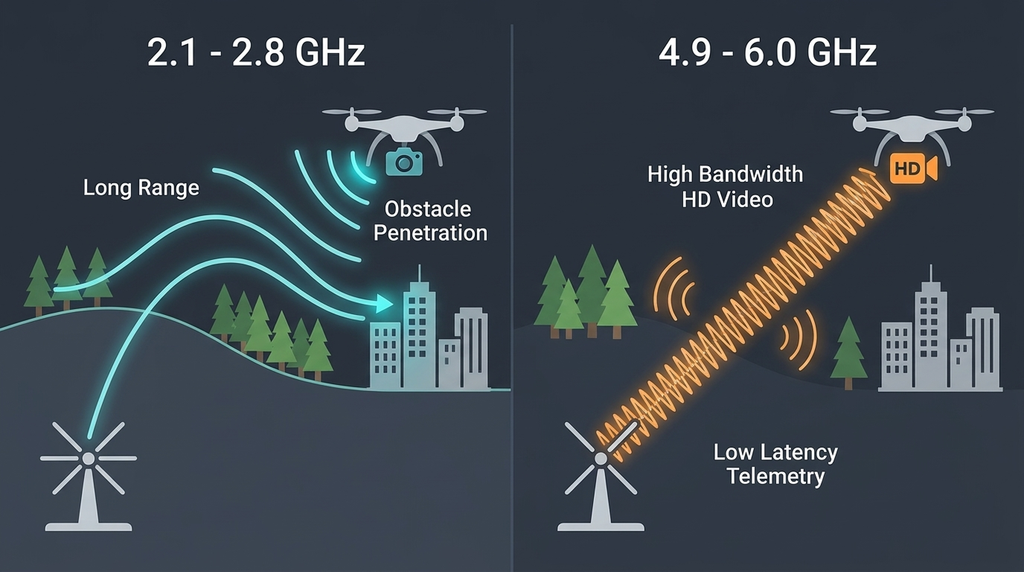
Command, control, and data transmission operate across two expanded frequency ranges: 2.1–2.8 GHz and 4.9–6.0 GHz. Each band exhibits distinct physical wave propagation characteristics that dictate tactical deployment in combat environments:
– Lower Spectrum (2.1–2.8 GHz): Demonstrates superior obstacle penetration and diffraction capability. Longer wavelengths effectively bend around terrain contours, penetrate dense tree canopies, and cut through urban structures. This serves as the primary spectrum for maintaining long-range, stable links when line-of-sight (LOS) is partially compromised.
– Upper Spectrum (4.9–6.0 GHz): Delivers significantly higher channel bandwidth, enabling high-definition digital video streaming and low-latency telemetry transmission. However, these higher-frequency signals suffer higher atmospheric attenuation and attenuation through solid obstacles, requiring precise directional antenna alignment.
Dynamic Adaptation: Multi-Channel Communication and FHSS
The aircraft are equipped with a compact, onboard radio transceiver delivering an output power of 1 W per channel. Transmission does not rely on a fixed static frequency; instead, the system continuously hops across multiple discrete sub-channels dividing both bands.
All video, telemetry, and command inputs are encapsulated into unified, cryptographically secured digital packets featuring packet delivery confirmation protocols.
How it Counteracts EW Interference
The transmitter continuously “hops” across channels in pseudorandom sequences (FHSS). If an adversary’s jamming station suppresses a specific frequency causing packet loss, the adaptive algorithm instantly hops to a distant, unjammed channel within the spectrum. Because the signal dynamically shifts frequencies in real-time, hostile direction-finding and wideband jamming systems physically fail to lock onto and suppress the full operational bandwidth simultaneously.
Onboard and Ground Antennas: Line-of-Sight and Signal Gain
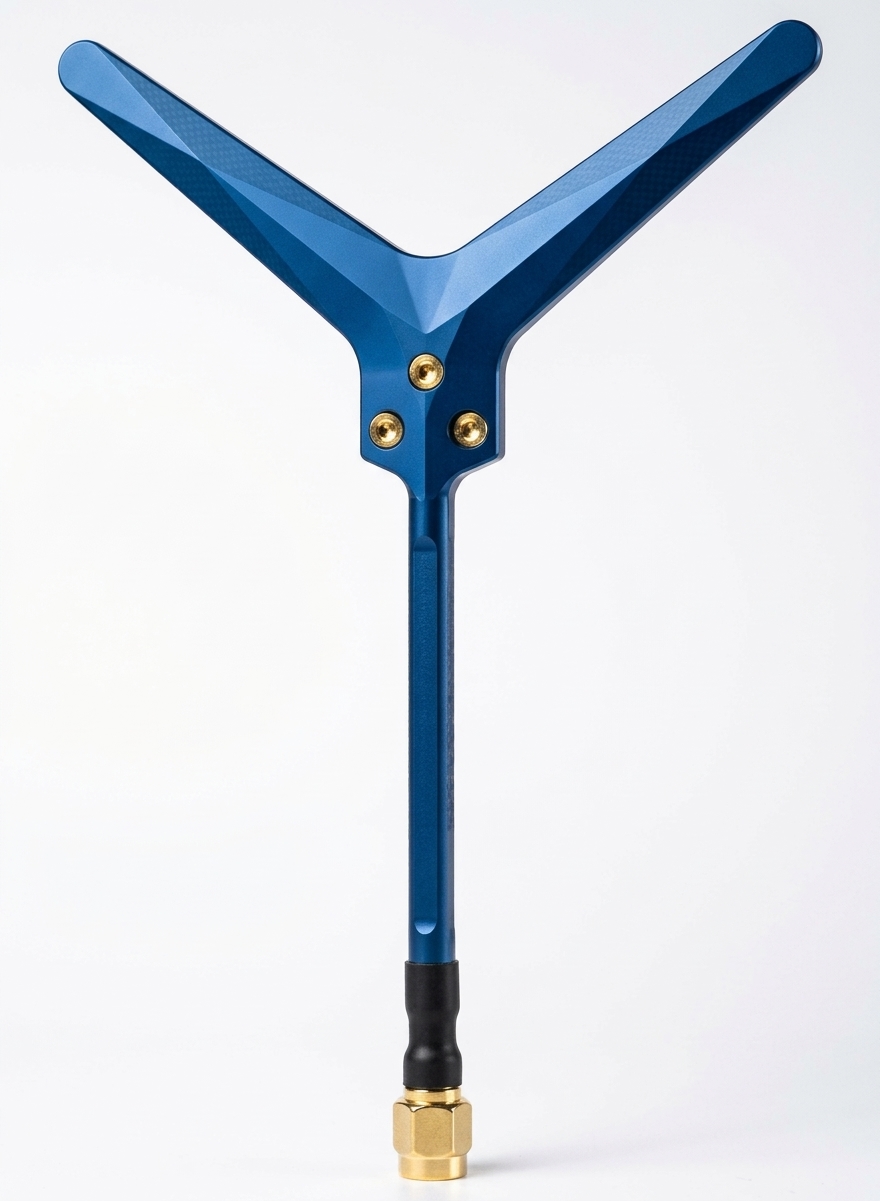
For onboard reception and transmission, SHMAVIK and KAZHAN platforms utilize omnidirectional dipole antennas (“stub” type). These generate a consistent 360° radiation pattern, ensuring uninterrupted link margin during aggressive maneuvering, banking, and pitch adjustments.
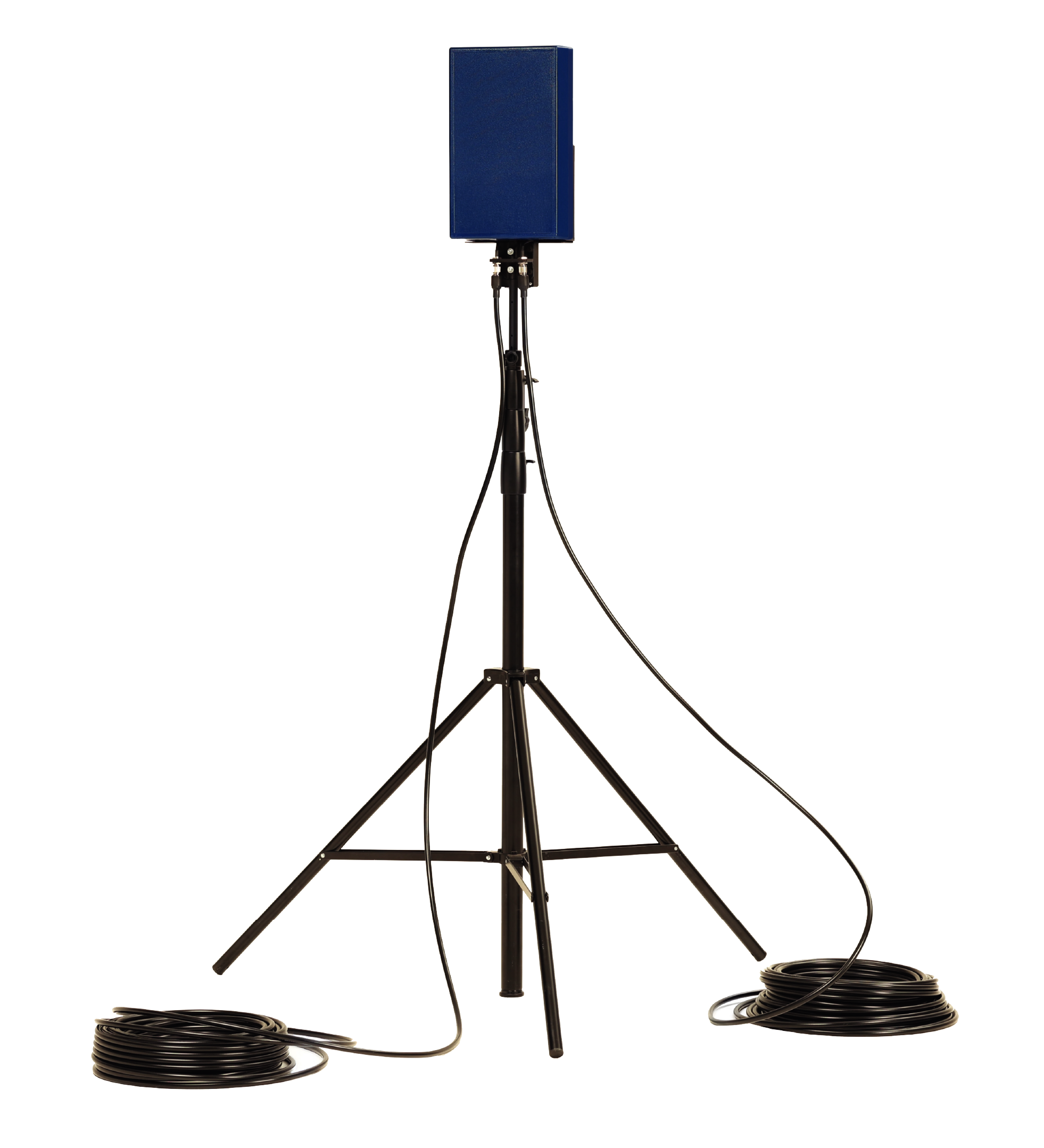
On the ground, elevation and directional antenna gain are paramount. Because microwave frequencies strictly depend on optical Line-of-Sight, ground antenna systems are elevated on 6-meter tactical masts.
To amplify signal reception and transmission power, the platforms utilize the Reactive Drone RAIV2 high-gain active directional antenna system:
| Parameter | Specification / Performance Metric |
| Operational Frequency Ranges | 2.1–2.8 GHz / 4.9–6.0 GHz |
| Antenna Gain (Passive / Active) | 12 dBi / 36 dBi |
| Channel Count & Power Output | 4 Channels, 4 W/Channel (100 W Max Equivalent Power) |
| Polarization | Dual-Channel: Horizontal (H) + Vertical (V) |
| Beamwidth Angles (H / V) | 30+-3 / 30+-3 grad |
| Front-to-Back Ratio (F/B) | 16 dB |
Dual polarization (H+V) guards against polarization mismatch fading as the drone tilts and rolls in flight. Meanwhile, the narrow 30 (grad) directional beam concentrates radiated RF energy precisely toward the aircraft while filtering out off-axis side-lobe noise and ground-based EW interference via a 16 dB Front-to-Back Ratio.
The synergy of dual wideband spectrums, high-rate pseudorandom frequency hopping, and the RAIV2 ground active antenna array establishes a closed-loop protective perimeter around the communications link.
This engineered resilience grants KAZHAN and SHMAVIK platforms exceptional operational range, deep terrain penetration, and robust EW suppression resistance — setting them apart from conventional tactical UAVs.